

- Name, age, where are you from, what format you like using, what are you currently working on if you are?
My name is Kieu Quoc Thai, I’m 25 and from Vietnam. I grew up between Hanoi, Tokyo and Shanghai, which has shaped the way I appreciate different places and the small details that make each one stand out. I mainly shoot digital on my Sony camera. Right now, I’m backpacking across Europe, photographing everything from urban liminal spaces to vast meadows filled with sheep. Back home, I’ve also been working on a longer-term project documenting urban displacement and change across Hanoi.
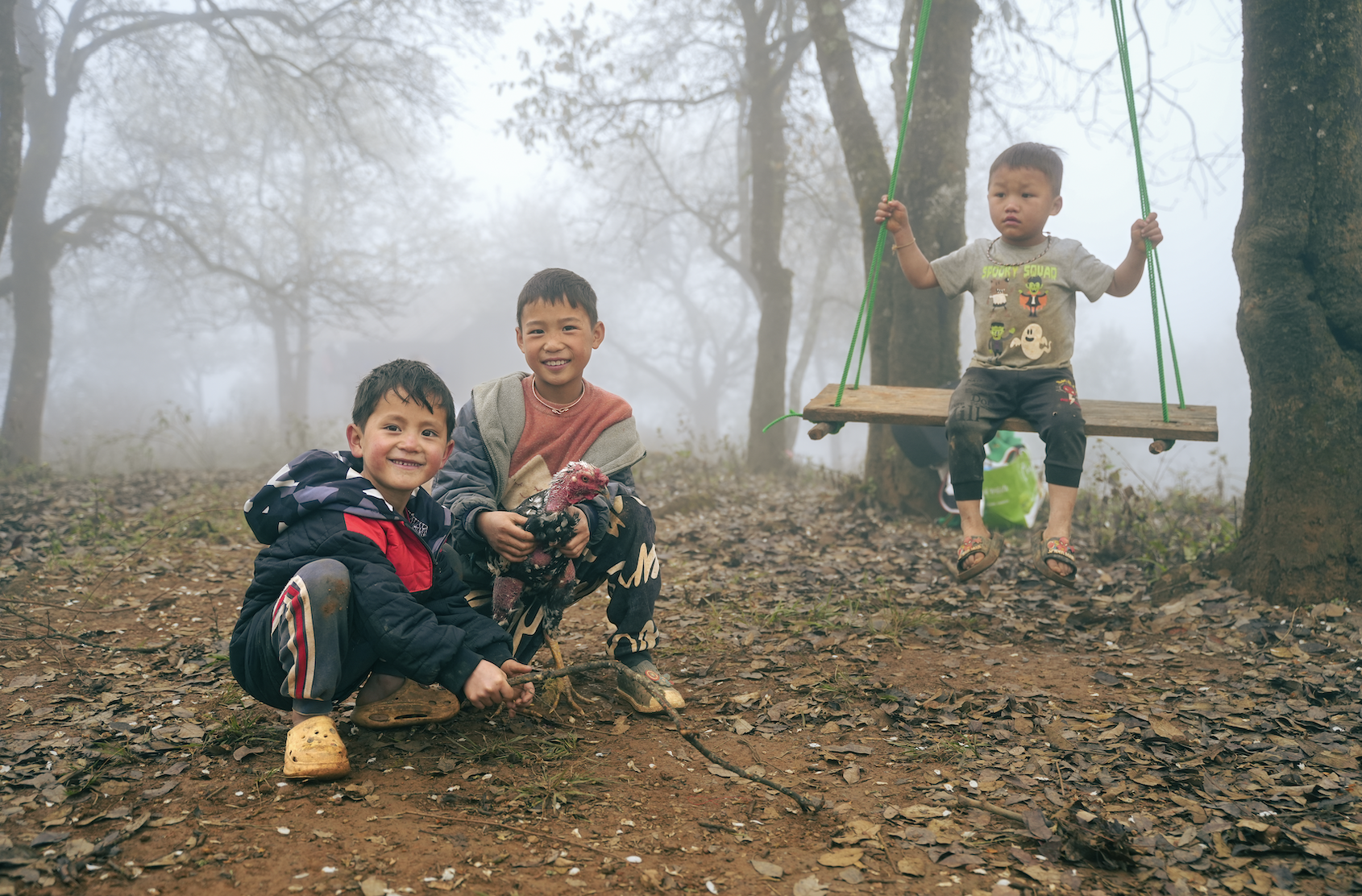
Nam Nghiep, Son La, Vietnam. Three children playing on a foggy morning in the mountains.
- What about your surroundings/environments and upbringing interested you?
I think what interested me most growing up between different places was seeing how the same everyday activity could feel completely different depending on where you were.
Transportation is probably the easiest example. In Hanoi, getting around usually means being on a motorbike, surrounded by hundreds of little engines whizzing around you at once. There are horns, exhaust fumes, dust, wind, the smell of food from the street. You feel everything almost simultaneously. In Japan, I remember the opposite experience of being packed into a train carriage where everyone is quiet, listening to music, reading, or staring at their phones. Both are just ways of getting from one place to another, but the atmosphere around them is completely different.
Even something as simple as coffee has its own rhythm. Vietnamese coffee culture can be incredibly slow. You sit around a small table, wait for the coffee to drip, talk, watch the street and sometimes stay much longer than you intended. In Japan, coffee can often feel much more tied to movement— grabbing one from a convenience store or café before work and continuing with your day. I became fascinated by those small contrasts and the way places shape even the most ordinary habits.
But I think what interests me even more now is how temporary all of those environments are. A street can feel completely alive one year and disappear the next. You might photograph children playing outside, elderly neighbours sitting together and talking, and then come back later to find the whole area fenced off for construction. Having moved around a lot since childhood, I became very aware of what it means to lose a place, both by leaving it and by returning to find that the version you remembered no longer exists. I think that awareness is one of the main reasons I feel such a strong urge to photograph.
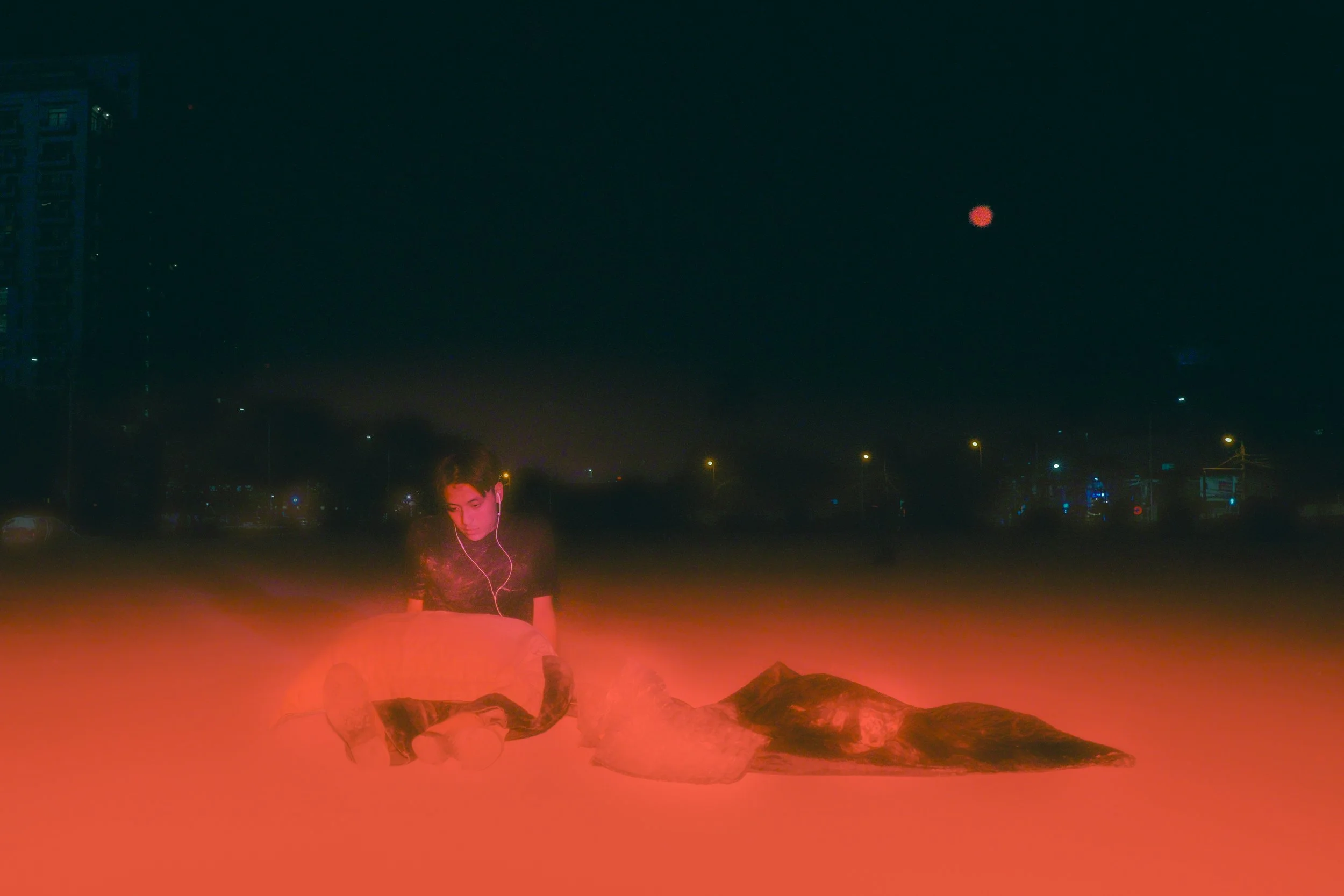
Untitled. Beds and blankets on the ground, shot with red flash
- When was the first time you met photography? How did you feel when you met it?
I remember the exact date: 27 March 2015. I was 14. I borrowed my mom’s Canon IXY compact camera on my way to pick up my little brother from school and, for whatever reason, photographed a tree. That was it. The rest is history.
Photography gradually became a way for me to express something internal through the physical world around me. I also make music and used to draw a lot, and I still love both mediums. But there’s something very physical and inviting about photography. It asks you to go outside and interact with your environment. You walk, look, wait, get closer, talk to people, notice the light, notice a building, notice a tree you might have passed a hundred times before. By training my eyes to photograph the world, I think I accidentally trained myself to appreciate it more. Photography taught me how to see.
It’s funny because at 14, I thought becoming a better photographer meant eventually having enough money for an expensive camera that could make sharper, higher-resolution images. Now I have a $2,000 Sony and still find myself going back to that same little Canon camera. I care much less about technical perfection now. Sometimes a blurry, low-resolution photograph makes me feel far more than the sharpest image ever could.
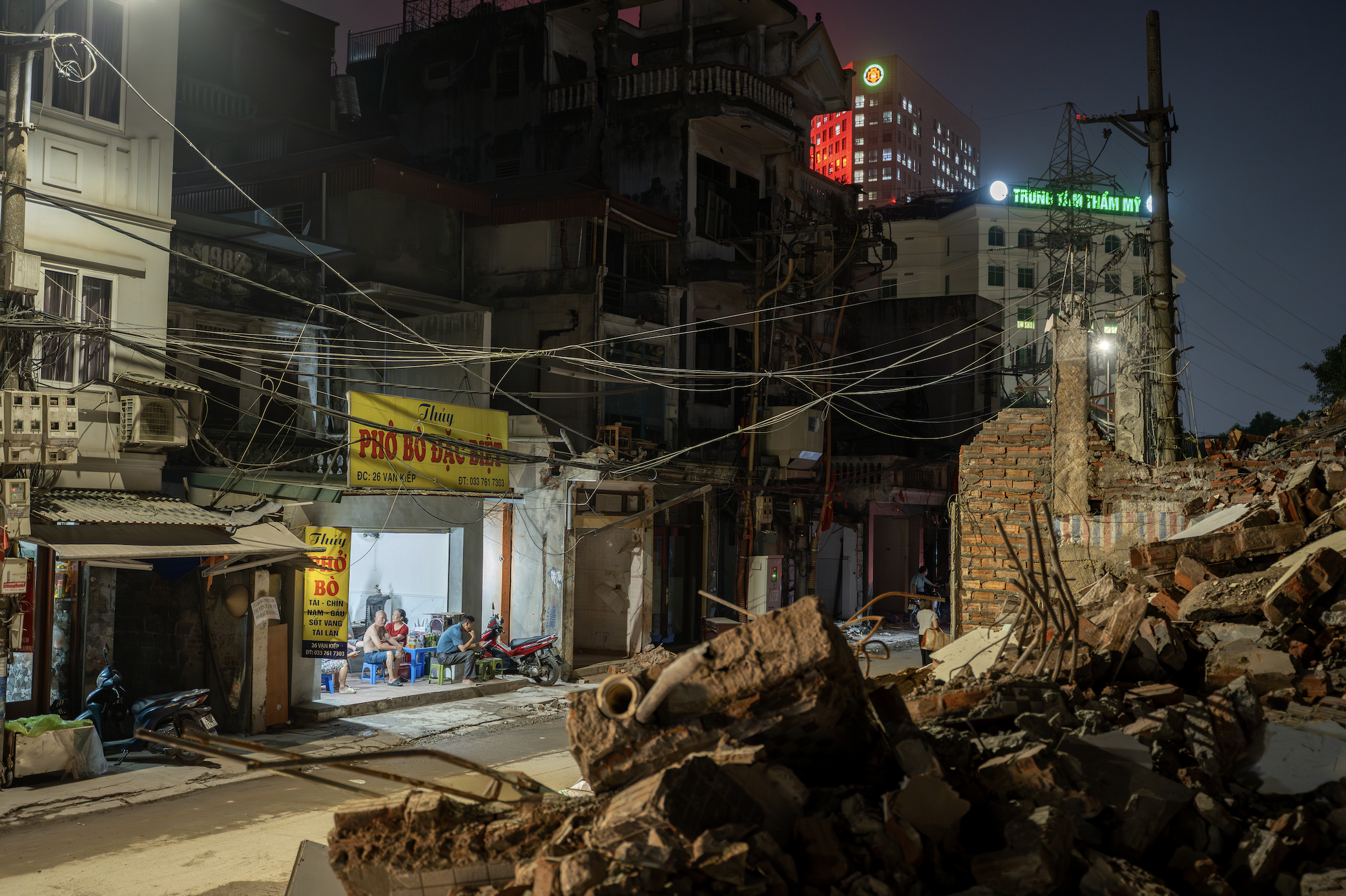
Vạn Kiếp Street, Hanoi, 2026. Residents sit outside a phở shop beside buildings being cleared for redevelopment.
- Tell us about current projects you have been working on (could be any, or just work you have been doing in general). Is this story inspired out of personal reasons, or others? What are you most excited about in these projects?
I’m currently working on two quite different bodies of work. The first documents urban displacement in Hanoi, where redevelopment and infrastructure projects are reshaping parts of the city. I’ve been photographing neighbourhoods during this transition, focusing less on construction itself and more on the lives around it.
Displacement isn’t simply moving from one house to another. It can change where someone works, where their children go to school, who visits their business, where they shop and the community they’ve built around themselves. I try not to begin with my own judgement about these changes, but instead document what I see and what the people experiencing them tell me. I want the photographs to bear witness to the people, homes and everyday scenes that might not be there tomorrow.
My other work is much more personal. While travelling through Europe, I’ve been photographing cities around dusk and night, often using coloured flash. I’m especially drawn to places that seem built for people but are unexpectedly empty: a vacant bench, a shuttered shop, a silent residential street. Magenta interests me because it feels strangely artificial compared with colours we constantly encounter in nature. Against the blue light of dusk, it can make an otherwise ordinary environment feel cold and slightly unnatural.
I don’t think too much about any of this while I’m actually photographing. I just find myself drawn to these spaces. Looking back, I think they reflect something about having moved between places throughout my life: the strange feeling of being somewhere familiar while never quite feeling that you belong. What excites me is that I don’t completely know where either project will end up. One asks me to step outside myself and pay attention to other people’s experiences; the other allows me to turn inward. In different ways, both keep bringing me back to places in transition.
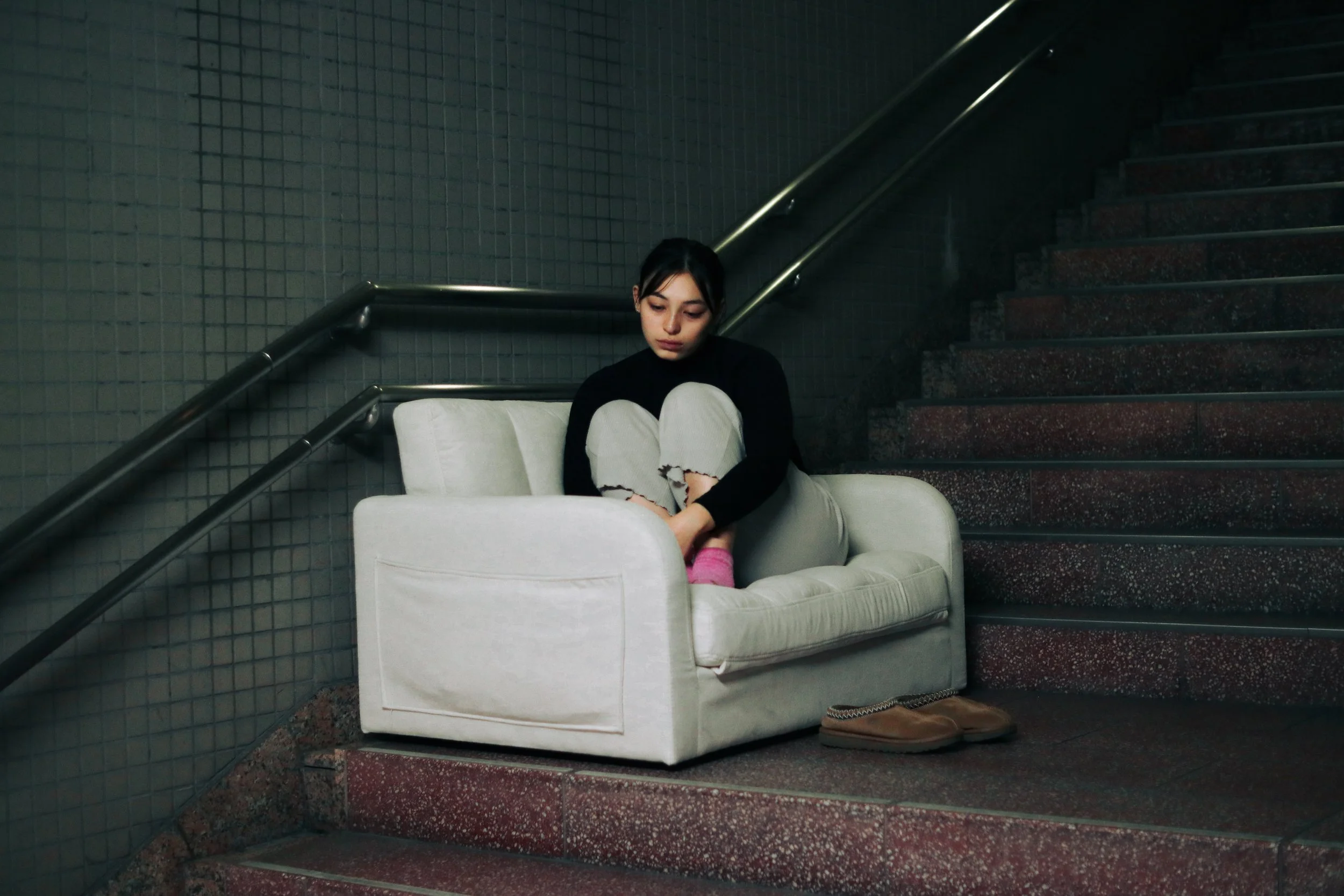
Liminal Space and the Art of Transition, Yokohama, 2023 Girl on a sofa on the subway stairs
- How did you find your visual literacy? Why are you attracted to certain images more than others?
My visual literacy came from a mixture of photography and cinema. I’ve always been drawn to the colours and atmosphere of Wong Kar-wai (cliché, I know), the depth in Edward Yang’s compositions, the way Elliott Erwitt photographs people, Henri Cartier-Bresson’s timing and Fan Ho’s use of light.
I also use a lot of film emulation in my work, and I think nostalgia plays a part in that. Growing up between different countries meant I never really had one stable environment throughout my childhood, so I find myself attracted to mundane scenes of continuity: children playing outside, people sitting around talking, everyday life unfolding without anything particularly important happening.
Philosophically, Joel Meyerowitz and Luigi Ghirri have probably influenced me the most. My favourite photograph is Meyerowitz’s Dune Grass. There’s almost nothing conventionally spectacular about it. There’s no obvious subject, the image feels strangely flat, and the house is awkwardly pushed against the edge of the frame. Yet that incompleteness is exactly what keeps me looking. I’m attracted to photographs that don’t reveal themselves immediately. It’s easy to direct someone toward an obviously beautiful subject or dramatic moment; I think it’s much harder to make someone stop and look when less is being shown.
In his essay The Vanishing Point, Luigi Ghirri writes about an increasingly obsessive desire to make everything visible: “This gaze is all-consuming and even slightly pornographic, attempting to see everything at the same time, to grasp and make visible an obsessive kind of looking which does not permit the subtle prizing open of the secret that things, faces and landscapes still possess.” That idea has stayed with me. I don’t think a photograph necessarily becomes stronger by revealing more. Sometimes what it withholds is what keeps you looking. For my creative work, I like leaving that space for the viewer, to wonder what lies outside the frame or what might be happening beyond what they can immediately see.
Documentary photography is different for me. I try to communicate the situation as honestly and holistically as I can. A photographer will always have an aesthetic voice, and I don’t think that needs to disappear, but it should be secondary to the people and information being documented. I want the way I photograph something to serve the story rather than make the story serve my photography. Mystery can still exist, but I think it should come from the reality in front of the camera rather than being manufactured for the sake of the image.
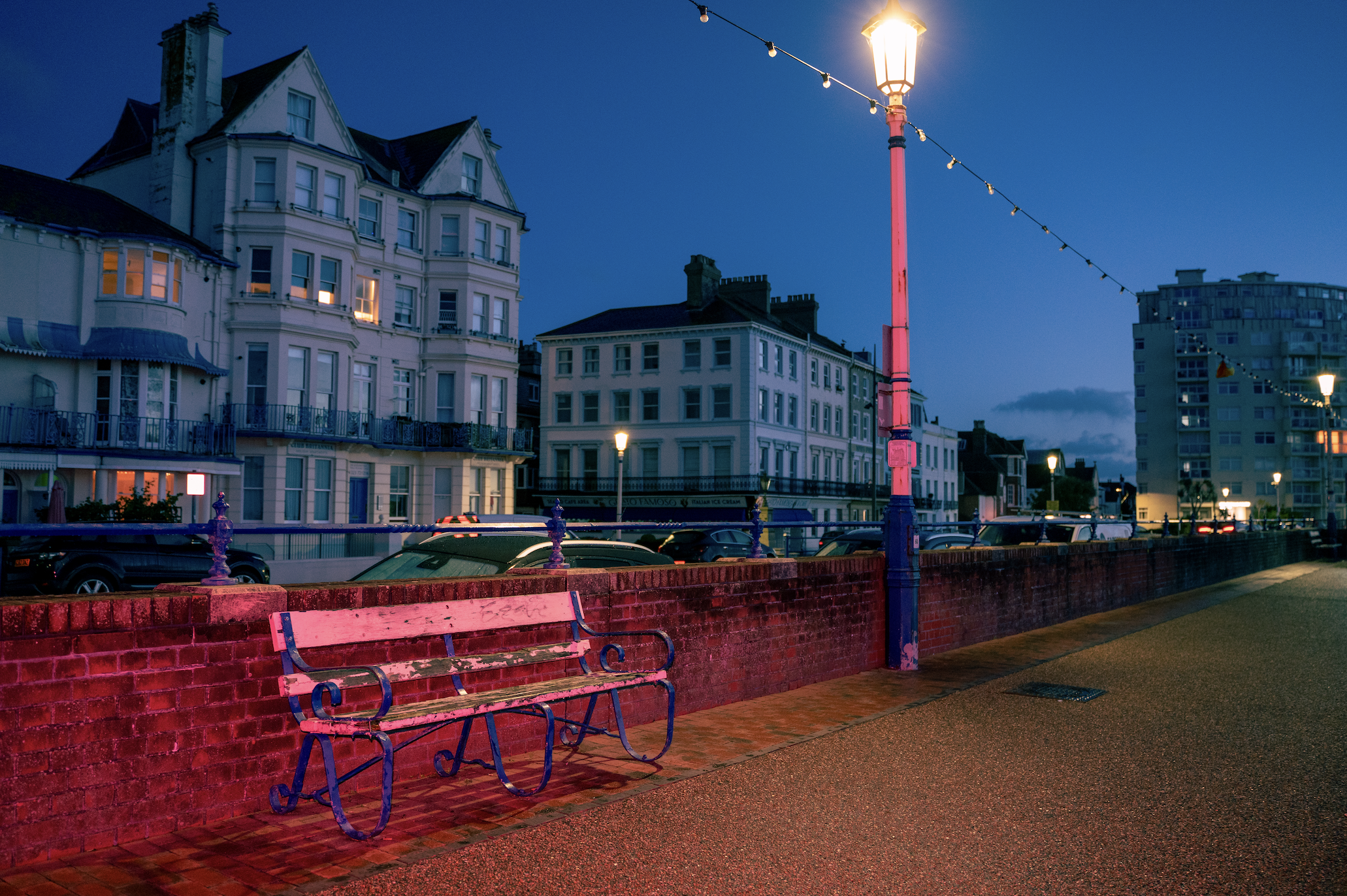
Eastbourne, England, 2026. An empty bench photographed at blue hour with magenta flash.
- Imagine meeting someone who is picking up a camera for the first time. What do you tell them?
Have fun. It’s just a camera. You don’t need to make every photograph meaningful or beautiful, and you definitely don’t need to know what your “style” is yet. Photograph stupid things. Photograph badly. Photograph whatever makes you stop and look.
But more than anything, don’t forget to photograph the things that feel too ordinary to photograph. Take pictures of the people you love, your bedroom, your parents sitting around at home, your friends eating together, the street you take to work or school, the view from your window, birthdays, holidays, your neighbourhood, your favourite restaurant. It sounds cliché, but it’s cliché for a reason. A lot of these things feel permanent only because you see them every day.
One day someone moves away, a building gets demolished, your bedroom isn’t yours anymore, or everyone simply gets older. And suddenly that random photograph you took without thinking becomes incredibly important. So yes, learn about light and composition and all of that eventually, but first just take pictures. You’ll be glad you did